AEOLUS
Forecasts for worlds that will never be visited.
Five hundred and nine catalogued atmospheres. None of them reachable, all of them weather-bearing, every one of them doing something right now.
Nobody will
ever stand there.
Everything in this bureau is inferred. We have never seen a cloud on any of these worlds. What we have is a dip in starlight lasting eleven hours, a smear across a spectrum, the particular way a planet's shadow bends the colour of its own sun on the way past.
From that we build a wind. From the wind we build a season. From the season we publish a forecast, in the same plain register a coastal station would use for tomorrow morning — pressure falling, visibility poor, expect the front by dawn.
It is an absurd thing to do. It is also the only honest way to say what the measurement actually means: something is happening there, at this moment, whether or not anyone is ever going to be standing in it.
Method
Transit spectroscopy at 0.6–5.1 µm, phase-curve inversion, and a general circulation model run to equilibrium over 40 000 simulated years.
Confidence
Every figure carries an error bar we have chosen not to print. Assume the third digit is a hope.
Standing order
Publish daily. Publish when the instrument is down. Publish when nobody reads it.
What you are looking at
Ten thousand massless tracers walked through a curl-noise field. The field is divergence-free by construction, which is the same condition a real incompressible atmosphere obeys — so the tracers bunch, thin and braid the way actual cloud decks do, without any of them ever being told about a cloud.
Zonal bands
Alternating prograde and retrograde jets. The default state of any fast rotator with a deep atmosphere.
Terminator collapse
What a tidally locked world does when the day side finally out-pressures the night: everything runs for the dark.
The archive
is monochrome.
The array records in flux, not colour. Everything you see here has been pushed through a two-tone transfer curve and a small amount of turbulence displacement — an honest lie, applied consistently, so that a human eye can find the structure a photometer already found.
Drag the divider on either plate to pull the treatment off and see the raw exposure underneath.
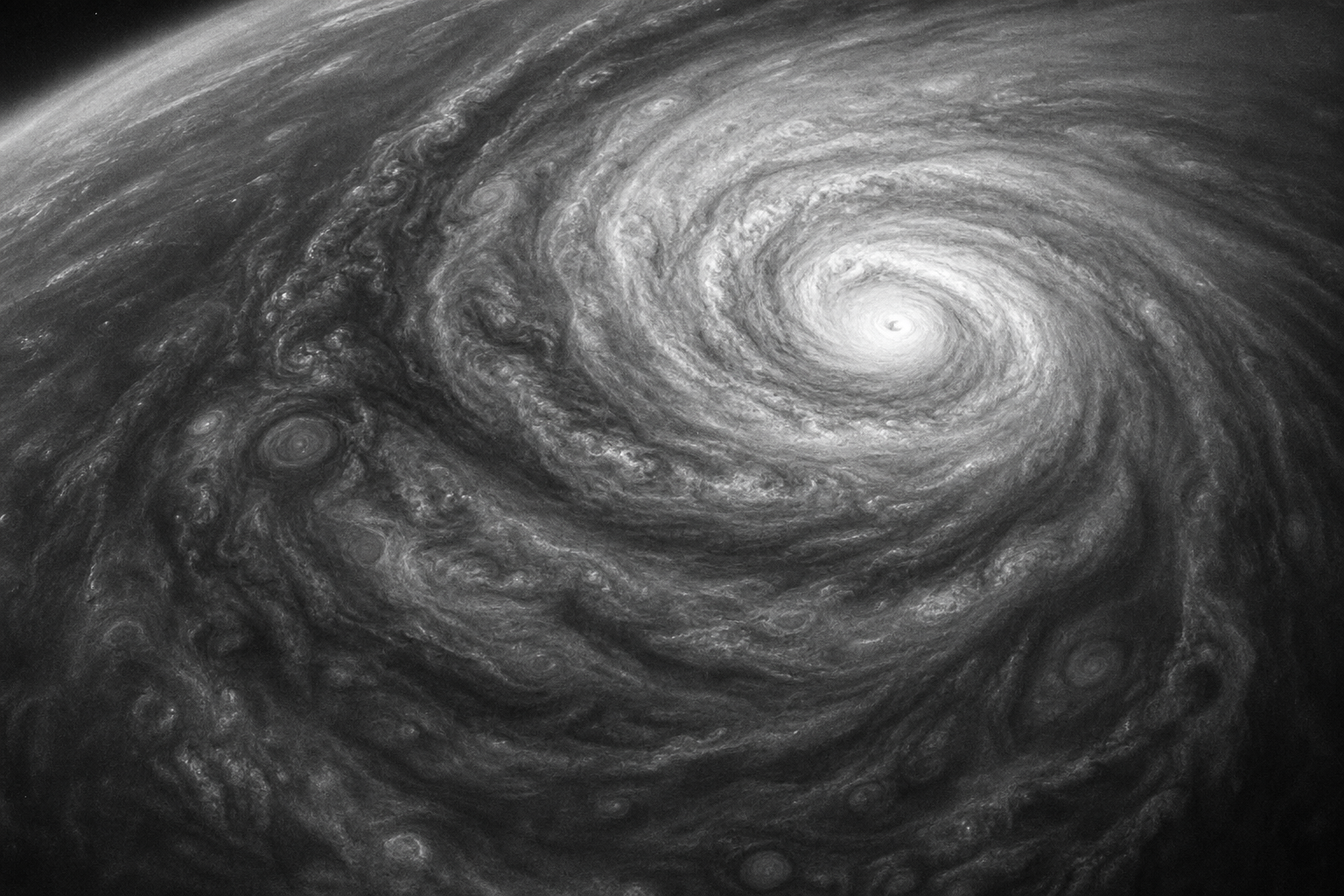
Meridian, unmoved since first light Plate 41-C
Exp. 240 s
1.4 µm
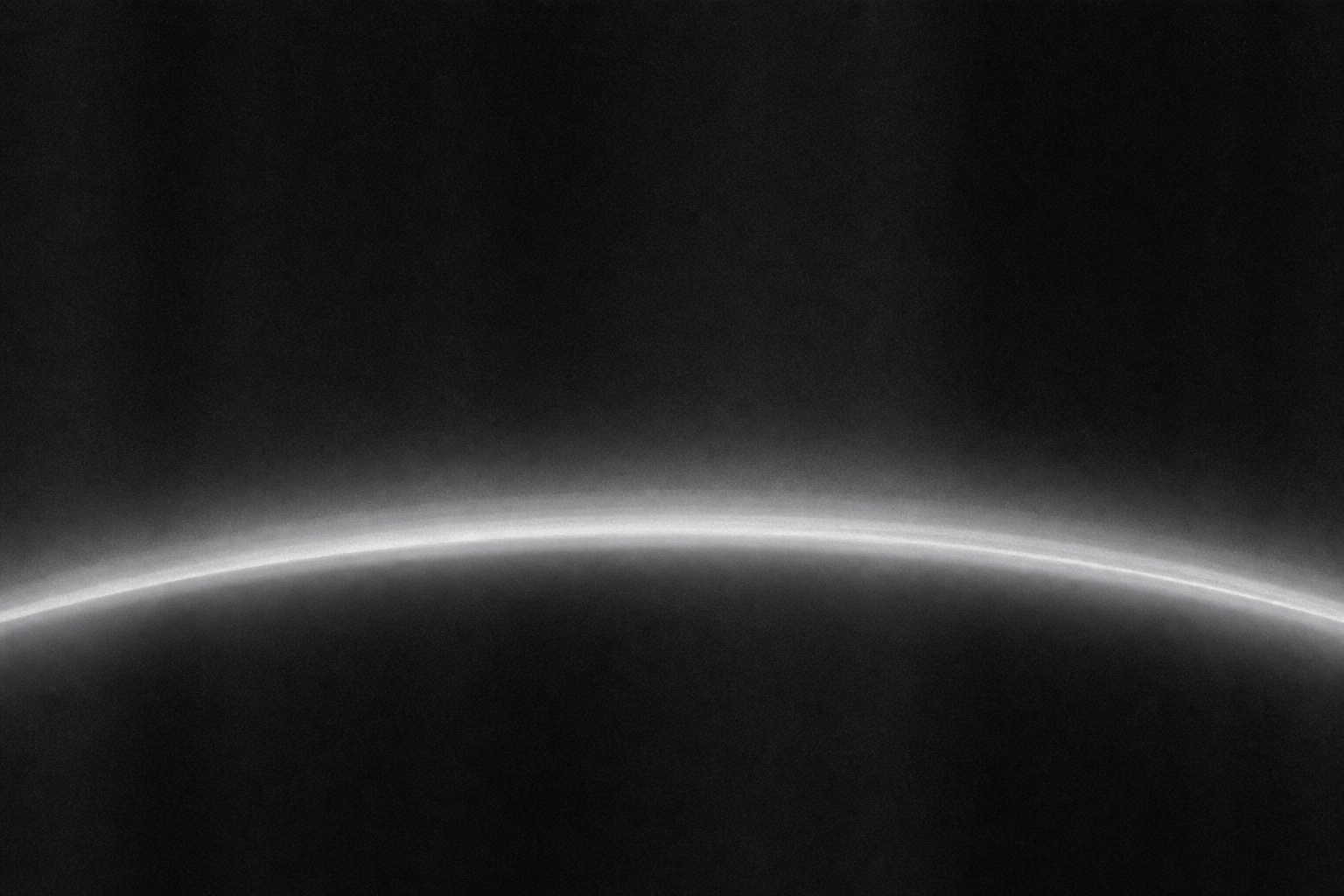
nine haze decks resolved Plate 88-A
Exp. 1 020 s
2.7 µm
Listen to
the transit.
A transit is a shape in time: a shoulder, a floor, a shoulder. Drop it thirty-four octaves and it becomes a note you can actually hear — the depth becomes pitch, the duration becomes length, and the atmosphere shows up as the roughness on the edge of the tone.
Nothing here is a recording. Every sound on this page is synthesised in your browser from the same numbers printed in the catalogue.